
Claiborne County Court Records After Arrest
A Claiborne County arrest usually creates two tracks. The first is the jail track: booking, jail docket entry, custody status, bond notes, release, transfer, or hold. The second is the court track: first appearance, affidavit or complaint, prosecutor review, filed charge, case number, hearing dates, orders, and disposition. The jail track can start fast, while the court track may take longer because a prosecutor or grand jury can change what was first written on the booking paperwork.
The official Claiborne County courts page places a key local step in Justice Court. Justice Court hears DUI and county ordinance matters, and felony cases are first heard there for an initial appearance and the filing of an affidavit. The same county page says Justice Court judges hold jail court sessions three times each week so people arrested in Claiborne County receive an initial appearance within three days. Felony matters then move toward Circuit Court after review by the prosecutor and, when required, indictment or information.
For custody and booking details, use the Claiborne County jail inmate records path first. For booking photos, use the Claiborne County jail mugshots page. Court records after a jail arrest are a separate question: which court has the case, which charge is filed, and what the judge or clerk record shows now.
The Claiborne County courts page is the local source for the first-appearance path, court offices, prosecutor contacts, and criminal jurisdiction notes.
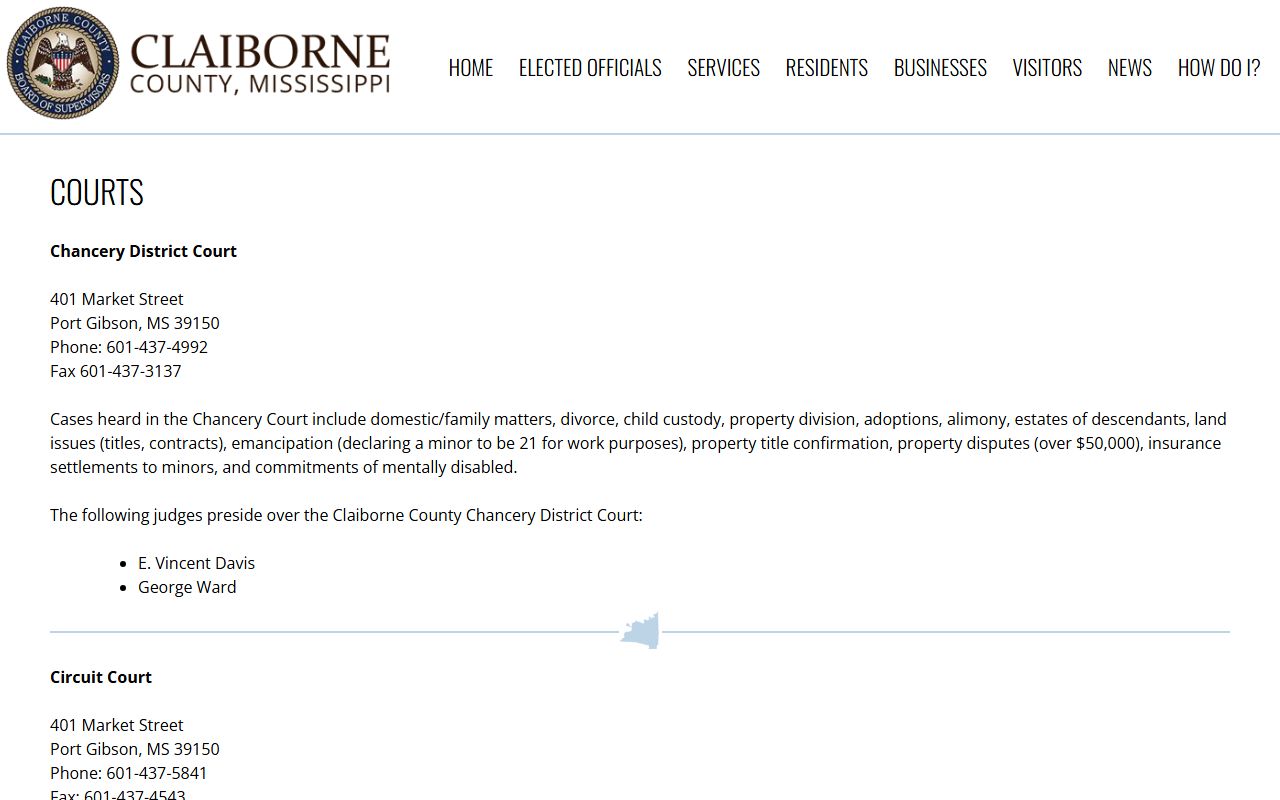
That county source is useful because it ties the jail arrest path to Justice Court sessions and later felony case routing.
Find Claiborne County Court Records
No single Claiborne County page was located that works like a public active arrest-to-court dashboard. The practical sequence is local and staged. Start with the sheriff or jail docket to learn the name, arrest date, booking charge, and whether the person is still in custody. Then contact Justice Court for first appearance and affidavit information. If the charge is a felony and moves forward, contact the Circuit Clerk or search through Mississippi Electronic Courts for the Circuit Court case.
- Call the Claiborne County Sheriff's Office at 601-437-5161 for booking status, arrest charge, bond status, and holds.
- Contact Justice Court at 601-437-4478 for first appearance, affidavit, DUI, ordinance, misdemeanor, or early felony hearing information.
- Contact Circuit Court or the Circuit Clerk at 601-437-5841 when a felony case has moved beyond first appearance.
- Use Mississippi Electronic Courts when the case is in a court and access is available through MEC or PAMEC.
- Ask the clerk which case number, defendant name format, and filing date range will narrow the search.
MEC is statewide, but online public access is not the same as a free county roster. Mississippi's judiciary reports statewide electronic filing for circuit, chancery, and county courts, while online public access normally requires registration, an account, login, and may involve fees. Courthouse access through the clerk remains the fallback when a person cannot search online or when the case is too new to appear in an index.
The Mississippi Electronic Courts page explains MEC access and the public access route for electronic court records.
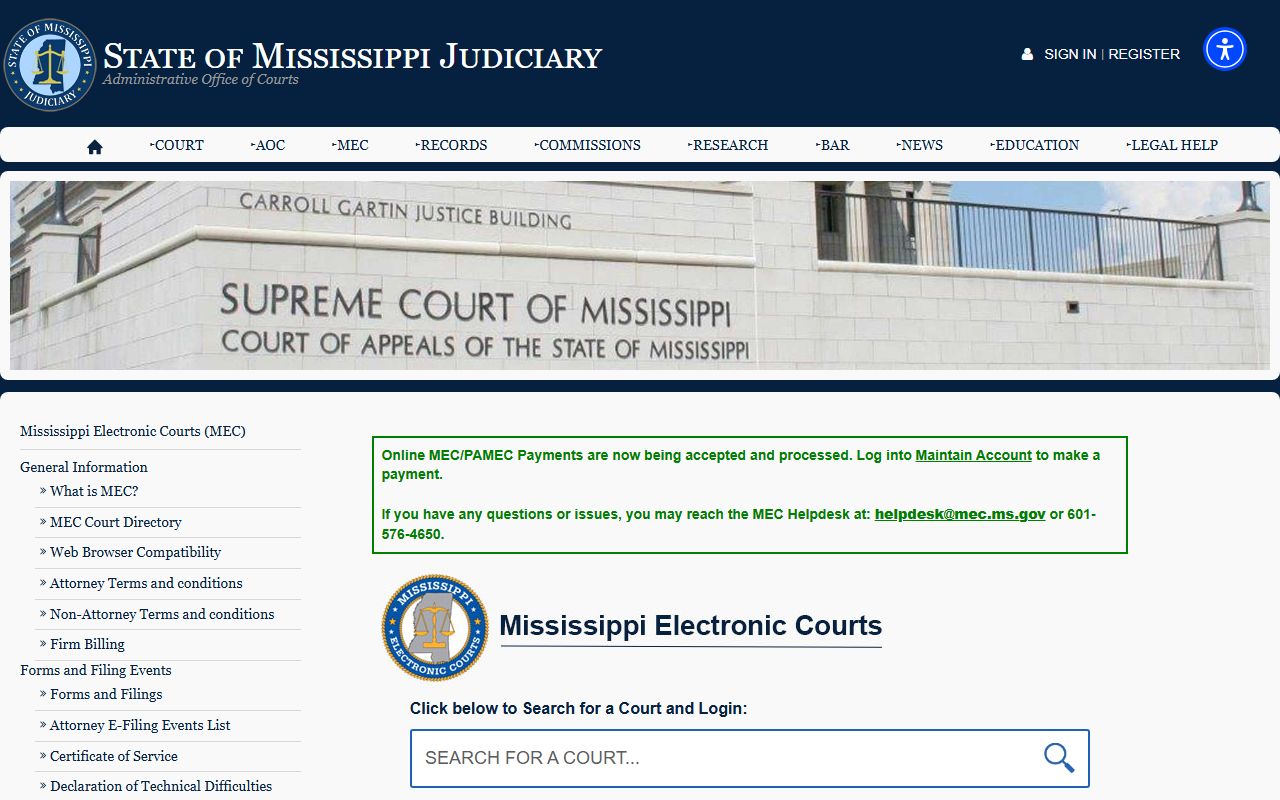
MEC should be read with local court contacts because early Claiborne County arrest charges may still be at the jail or Justice Court stage.
Claiborne County Arrest Court Contacts
Claiborne County court records after an arrest can involve several offices, depending on charge level and case stage. Circuit Court is listed at 401 Market Street, Port Gibson, MS 39150, with phone 601-437-5841 and fax 601-437-4543. The county describes Circuit Court as having original jurisdiction over civil and criminal matters not vested elsewhere. That makes the Circuit Clerk the key local contact after a felony indictment, information, or circuit criminal filing exists.
Justice Court is listed at 501 Market Street, Port Gibson, MS 39150, with phone 601-437-4478 and fax 601-437-3833. Justice Court matters include DUI and county ordinance cases, plus initial appearances and affidavits in felony cases. The County Prosecuting Attorney, Michael Keyton, is listed at P.O. Box 694, Anytown MS 39150, phone 601-437-3322, fax 601-437-0088. The county says that office represents the state in felony matters before justice or county court, handles criminal appeals from justice or county court to circuit court, may present matters to the grand jury, and handles misdemeanor youth court matters and other cases not assigned to the District Attorney.
The District Attorney is Daniella M. Shorter, P.O. Box 767, Hazlehurst, MS 39083, phone 601-894-5010, fax 601-894-9080. A routine custody or bond question still belongs with the sheriff, jail, or court clerk, not the District Attorney. Prosecutor contacts matter most when explaining who screens, files, presents, amends, or dismisses charges after the initial arrest paperwork.
Claiborne County Arrest Charging Records
The court record starts with a charging paper, not with the mugshot or jail intake note. In Claiborne County, a felony arrest is first heard in Justice Court for an initial appearance and affidavit. A misdemeanor, DUI, or county ordinance case may remain closer to Justice Court, while felony prosecution can move to Circuit Court once the prosecutor reviews the file and a grand jury or charging process supports the next step.
| Charging Record | Who Uses It | What It Means After Arrest |
|---|---|---|
| Affidavit or complaint | Officer, complainant, or prosecutor through Justice Court | Starts the early court record and supports first appearance, probable cause review, or misdemeanor handling. |
| Information | Prosecutor | Formal charge filed by the state when the law and procedure allow the case to proceed without an indictment. |
| Indictment | Grand jury | Formal felony accusation that can move the matter into Circuit Court for arraignment and later hearings. |
Booking charges and court charges can differ. The jail docket reflects the authority for receiving the person into custody, the cause of confinement, and the release or transfer path. Prosecutors can decline a charge, amend it, reduce it, add a related count, or present a different version to a grand jury. That is why a jail record may show one charge while the later Circuit Court record shows another.
Claiborne County Charge Status Records
Charge status is the part of the court record that tells whether the case is still active, changed, ended, or waiting on the next event. A status label should be read with the docket entries, orders, and disposition. A charge may stay pending after release from jail. Release means the person is no longer held on that jail booking; it does not mean the court case is over.
| Status | Plain Meaning | Where to Confirm |
|---|---|---|
| Pending | The charge is open and has not reached final disposition. | Justice Court, Circuit Clerk, or MEC when indexed. |
| Amended or reduced | The state changed the charge, count, level, or wording. | Filed orders, amended charging documents, or clerk docket entries. |
| Dismissed | The court record shows the charge was ended without conviction on that count. | Disposition entry or signed order from the court file. |
| Nolle prosequi | The prosecutor chose not to pursue that charge at that time. | Prosecutor filing, minute entry, or court order. |
| Convicted | The case ended with a guilty plea, verdict, or accepted adjudication on that charge. | Judgment, sentencing order, or final docket entry. |
When the status is unclear, ask for the full docket sheet or the latest signed order. A verbal summary can be useful, but a court record is the safer source for filing dates, case numbers, charge wording, and final disposition.
Note: Court records can lag behind a jail release, especially when a felony case waits for prosecutor review or grand jury action.
Charge Records vs Convictions
An arrest charge is an accusation tied to custody. A filed charge is an accusation in court. A conviction is a final outcome after a plea, verdict, or qualifying judgment. These are not the same thing. Claiborne County court records after a jail arrest should be read in that order so a pending charge is not mistaken for proof that the person was found guilty.
| Point of Comparison | Charge | Conviction |
|---|---|---|
| Stage | Accusation after arrest, affidavit, complaint, information, or indictment. | Case result after plea, trial, or court judgment. |
| Proof level | Based on probable cause or formal accusation. | Requires a guilty plea, verdict, or legal finding. |
| Record effect | May be pending, changed, dismissed, or later expunged if eligible. | May affect sentence, fines, supervision, and future record access. |
| Best source | Justice Court, Circuit Clerk, MEC, or charging document. | Final judgment, sentence order, or disposition entry. |
Bond Holds After Arrest
No Claiborne County bond payment schedule or online payment-method page was located. Call the sheriff at 601-437-5161 to ask whether bond has been set, which court set it, whether any hold blocks release, and where payment must be posted. For felony initial appearances, Justice Court is the early point of contact. For a case that has moved into a court record, the Circuit Clerk or Justice Court can confirm court file status and the next court date.
| Bond or Hold | How It Works | Record Caution |
|---|---|---|
| Cash bond | Money is posted directly as ordered by the court or jail process. | Refund or application depends on the court order and local procedure. |
| Surety bond | A licensed bail agent posts the bond for a premium. | The premium is not a court fine and is generally not returned. |
| Recognizance or personal bond | The judge orders release without full cash payment, subject to court terms. | Missing court can cause a warrant or bond revocation. |
| No-bond hold | Payment does not authorize release unless the court changes the hold. | Confirm the issuing court before assuming a payment will release the person. |
| Agency detainer | Probation, parole, another county, MDOC, federal, or ICE authority may want custody. | A local bond may exist but release can still be blocked. |
A bond order affects custody, not guilt. A person can bond out and still have a pending Claiborne County court record. A person can also remain in jail because of another hold even when the local charge has a bond amount.
Warrant Court Records After Arrest
No official Claiborne County active warrant search, most-wanted page, or warrant app was located. Warrant information may be limited while a warrant is active, especially if disclosure could affect enforcement or safety. The local fallback chain is the sheriff at 601-437-5161, Justice Court at 601-437-4478, Circuit Court or Circuit Clerk at 601-437-5841, and a written records request for served warrants, jail docket entries, or incident reports.
An arrest warrant authorizes custody on an alleged offense. A bench warrant or capias often follows a missed court date or a court order. A search warrant authorizes a search and does not always mean a person is booked. A fugitive hold, out-of-county warrant, probation hold, MDOC hold, federal hold, or ICE detainer may explain why a person remains in the Claiborne County Detention Center after a local court event appears to be complete.
Public Court Records Limits
Mississippi public-records law supports access to many jail and court-related records, but it does not make every police or court file open at every stage. The Mississippi Public Records Act defines public records broadly, gives any person the right to inspect or copy nonexempt public records, and allows agencies to charge actual costs for search, review, copying, redaction, and mailing. It also treats incident reports differently from investigative reports. Incident reports are public; investigative reports may be exempt.
Mississippi's jail docket statute, section 19-25-63, requires the sheriff to keep a public jail docket with the warrant or mittimus, issuing authority, prisoner's name, dates received and arrested, cause of imprisonment, confinement authority, release authority, and transfer details. That jail docket can help bridge the gap when the court case is not yet easy to find in MEC or at the clerk's office.
Sealed Expunged Arrest Records
Some court records after a jail arrest can later become harder to see because of sealing, restricted access, or expunction. Mississippi expunction law, including section 99-19-71, covers eligible convictions and certain arrests that were dismissed, dropped, had no disposition, or ended in a not-guilty result. Eligibility depends on the charge, outcome, prior record, waiting periods, and the order entered by the court.
| Record Treatment | Public Effect | Practical Step |
|---|---|---|
| Sealed or restricted | The record is hidden from ordinary public view but may still be available to some courts or agencies. | Ask the clerk what order restricts access and who may inspect it. |
| Expunged | The arrest or case is treated as removed from public record under the court's expunction order. | Get a certified copy of the order and confirm each agency received it. |
| Dismissed, dropped, or not guilty | The charge ended without conviction, but the record may still appear until expunged or restricted. | Request the disposition and ask whether expunction is available. |
Juvenile matters, sealed filings, ongoing investigations, and some law-enforcement records may be unavailable to the public. If a public copy is denied, ask for a written denial that cites the legal basis and tells which record was withheld or redacted.
Using Court Records Carefully
Claiborne County court records after an arrest are best used to verify the case path and current status, not to make assumptions from the booking charge alone. Match the person's full legal name, date of birth if available, arrest date, court, and case number. Check whether the record is a jail docket entry, Justice Court first appearance, Circuit Court felony filing, or final disposition. Each source answers a different question.
Important: Do not use jail, court, or linked public-record information for credit, employment, housing, insurance, or another FCRA-regulated purpose.